Big Energy Rip-Off

MON POWER TRYING TO STICK IT TO CONSUMERS WITH HARRISON POWER PLANT PURCHASE

See Jim Kotcon’s excellent explanation of Mon Power’s attempted cash grab: “Mon Power’s Billion Dollar Boondoggle.”

It’s time to get rid of Mon Power, altogether. Municipalities can purchase energy companies’ infrastructure and supply energy direct to municipal residents. And there are other options, including bidding or contracting for energy in the market, or leasing infrastructure. [Further, in some states municipalities can by law condemn energy companies, if need be, to purchase for fair value. Such a law should be passed in West Virginia. See the “Survey of State Municipalization Laws.”]

When a municipality owns a power plant, then consumers pay their power bills to the municipality and thereby gain direct control over who they pay their power bills to, given that municipalities are run by elected officials. Power plants owned by municipalities cut out the profit skimming middle men (business entities, which as we have seen are too often swindlers), who are not accountable to election nor recall, nor to many forms of transparency that government officials are legally bound to.

It’s long since time to get rid of Mon Power – especially now that their dirty dealing is so blatant in this Harrison Power Plant cash grab. Read the rest of this entry »

Name That Stadium!

EVERY SCANDAL DESERVES A FITTING NAME

Let’s call it what it is. The “Ballpark TIF” stadium being built for WVU with at least $16.2 million of local taxpayer funds should be called what it is. It’s the Gift-Theft Center. (To be kind. One could think of more colorful names.) The GTC.

Monongalia County is building a baseball stadium for WVU, for free! Yes, the Gift-Theft Center. Hey, give those County Commissioners, who voted for the thing, box seats at the 50 yard line, at half court, behind home plate. The Commissioners are now actual WVU celebrities! It’s not every day that WVU Sports receives a gift (tax free!) worth tens of millions of dollars from the local taxpayers. Wow, give us all box seats at the 50 yard line. Looks like we’ve earned it. Does anyone suppose if we all showed up at once on the 50 yard line, at half court, behind home plate they could turn us away? Wave copies of the “Ballpark TIF” bill and point out the facts: we bought these seats.

Really looking forward to the $20 million revenue generating community exercise and recycling and health food center that WVU builds and gives free to the taxpayers of Monongalia County in the next few years, plus tens of million WVU dollars more for physical and social infrastructure support like street paving and homeless services and parks development and power line burial. The WVU Foundation has assets currently worth $1.2 billion – above and beyond the $1 billion annual WVU budget – so a modest $20 million multi-use actual needs center built by WVU for county taxpayers will be no problem. Thanks WVU! And thank you Monongalia County Commission and West Virginia State legislature, and WVU Athletic Director Oliver Luck, and Mon-View LLC for making the $20 million Actual Needs Center for Monongalia County such an unbelievable prospect. Read the rest of this entry »

Own It And Operate It Expansively – The TIF Ballpark And Other Parts Of The TIF District

THE “BALLPARK TIF” DISTRICT DOES NOT EXIST IN ISOLATION, THEREFORE FUNDS SHOULD BE USED, CONTROLLED, AND GENERATED IN THE TIF DISTRICT BY THE COUNTY, TO DIRECTLY SUPPORT AND BENEFIT AS WELL THE ENTIRE COUNTY AND REGIONAL PUBLIC

Or: HOW TO AVOID LOWEST COMMON DENOMINATOR SPRAWL IN THE “BALLPARK TIF” DISTRICT

Or: A GOOD EARLY USE OF IMAGINATION COULD GO A LONG WAY TOWARD MAXIMIZING THE PUBLIC BENEFIT OF THE “BALLPARK TIF” PLAN

As long as the monies are now locked in, Monongalia County badly needs major public facilities and services created and located in the new “Ballpark TIF” district. Tens of millions or hundreds of millions of local tax dollars are now by law obligated to be spent in that district over the next 30 years, so there had better be a lot that is firmly under public control by the end of the three decades. There had better be a whole network of county facilities and operations providing services and infrastructure for the district, for the surrounding areas, and for the general public in ways that serve and can be used by the entire county population, who come and go from the TIF district or live near it (which essentially everyone in the county and region does). No sector functions in isolation. What happens in this large designated TIF district will have a huge effect on the rest of the county and the region, even state. Thus broad county (and state) needs should be funded in this district, as well as the micro area TIF district needs.

The county should outright own the ballpark site and the stadium and use the whole ballpark site for multiple uses that benefit the entire county, as well as the TIF district.

The sweeping parking lots of the ball stadium could be used on a regular basis – year round – for a recycling center and regular recycling dropoff events. There will be no ball games in the winter at the ballpark, so it had better be well used during the cold months for county needs, since it will be all county and local taxpayer funds that are used to build and landscape the entire stadium facility and site. Quality outbuildings and other infrastructure should be built on the ballpark acreage to help provide such services. The “ballpark facility” should be named something like: The West Virginia Monongalia County Center (The WVMC Center).

A county medial clinic could be built somewhere in the TIF district, including counseling services and drug and alcohol rehabilitation opportunities to serve the TIF district and county.

A low-cost but healthy county grocery (and essentials) store and county eateries should go in. Hey, why should only wealthy private businesses generate revenue from the flood of local tax funds that have been committed to the district? That would be special interest business theft of public funds.

A high quality public exercise and recreation and community center should be built and geared especially toward wintertime use, to help alleviate area depression and a whole range of mental and physical ailments and diseases too common to Appalachia. Such a center could readily be financially self-sustaining once built – not unlike a ballpark.

Many other TIF fund uses and public needs could be paired. The county should put out a call to all regional social welfare services, planning groups, and community organizations to gather ideas, and to plan to get together to make a reality as many good ideas as possible that well serve the public. Otherwise, the TIF district is likely to transform over the next three decades into lowest common denominator sprawl.

The County Commission should work very hard to make sure that the three decades of local taxes collected as part of this Tax Increment Financing plan will generate a lasting public impact and generate sustainable and renewable public revenues directly to the county too, and not only to the businesses who are licking their chops at the banquet of local public funds soon to be rolling their way. Read the rest of this entry »

The Great Swindle – Part Four

WHOSE BALLPARK IS IT?

The Monongalia County “Ballpark TIF” is not supposed to be a charity for WVU. The public is funding the baseball stadium. WVU is not. So the public should own the baseball stadium. WVU should not.

The public is funding the multi-use baseball stadium with local tax dollars to the tune of $16.2 million, plus building an adjacent interstate highway interchange with local tax dollars costing $28 million, plus providing additional millions in near vicinity infrastructure.

WVU is purchasing a 7 acre site for the ballpark from private developers for $2.1 million. Compare WVU’s $2.1 million to the local taxpayers’ $16.2 million plus $28 million plus untold other TIF plan millions. Yet WVU claims ownership of the stadium via WVU associate general counsel Rossi Wiles:

“By law, whoever owns the ground, pretty much [the baseball stadium] would go…to that entity, which, we do believe to protect the university’s interest and to play our baseball games, it really should come to the university.”

Wealthy entities, like WVU athletics, can afford to buy and build their own ball fields and stadiums. The public’s tax dollars should not be used buy a new baseball stadium for WVU athletics, nor for anyone else. After all, the owners are going to make the bulk of the money off the stadium facilities, and the owners will get the highest priority use of the stadium facilities, so they should pay for it. If WVU would like to set up a payment plan to repay Monongalia County (and the state), then I’m sure the Commissioners would be glad to help make such arrangements.

We should’ve seen it coming – WVU Athletic Director Oliver Luck pushing tens of millions of public dollars into the pockets of the wealthy through ballfields in Texas and West Virginia.

Since June 2010, Oliver Luck has been the Athletic Director at West Virginia University. A former WVU quarterback, NFL quarterback for the Houston Oilers, and a West Virginia Republican (failed) congressional candidate, Luck returned to WVU after working as head of the Houston Dynamo soccer team and head of the City of Houston and Harris County Sports Authorities, where he helped to secure public financing for the new Houston Dynamo soccer stadium.

The City of Houston and Harris County were convinced by Oliver Luck and his colleagues – it took five years – to put $35 million dollars (the public’s tax dollars) into buying the site for a new Dynamo soccer stadium and for making infrastructure improvements. The Dynamo put $60 million into the stadium – much of which was then immediately covered by stadium naming rights (sold to a bank) and other multi-million dollar deals made by the Dynamo, while the city of Houston and Harris County were completely iced out of most or any such deals. In other words, the Dynamo owners could swiftly make back their investment in the stadium facility, whereas the city/county taxpayers’ investment was not necessarily recoverable. Similarly here in Monongalia County – why should WVU get away with not paying back to the local taxpayers the millions it plans to take from them to build a stadium to be owned, controlled, and used by WVU? Recall, WVU is backed by its own massive income, including by its $1 billion annual budget and additionally by the WVU Foundation, Inc, which currently holds $1.2 billion in assets.

It’s a sick and abusive relationship for local taxpayers in Monongalia County, where nearly 22 percent of the population lives below the poverty line, to be subsidizing a ballfield costing tens of millions of dollars for the gold stockpilers behind the WVU athletic department, which – oh by the way – pays the football coach Holgorsen $2.5 million per year, and basketball coach Huggins $3 million per year, and athletic direct Luck $.7 million per year, for a combined $6.2 million paid each and every year to a mere three employees at WVU athletics. WVU should get out of the public’s pockets and pay for the damned ballfield itself. Read the rest of this entry »

No Bus, No Test

NO SIGN OF CONCERN FROM THE SCHOOL BOARD AND THE SUPERINTENDENT’S OFFICE

Below is the automated message that parents receive from the Monongalia County Board of Education when the BOE fails to supply a school bus on regular school days. Never an apology with the notice, of course. The message below arrived, unlike the bus, this morning. The bus carries Eastwood Elementary, South Middle, and Morgantown High students. Of course this week is state testing, Westest week at Eastwood Elementary and other schools, but these students have no bus available to get to school for the tests. These transportation failings are becoming a regular occurrence in Monongalia County Schools.

And then, shortly before the actual start of the school day today, Eastwood Elementary parents received an apologetic automated phone call from Eastwood Principal Hartshorn. She apologized twice for lack of a bus. She said if students had no way to school they could make up the Westest tomorrow. Apart from this apology today from Eastwood Principal Hartshorn has anyone ever heard an apology for this basic failing, lack of public bus service, from anyone else in the BOE?

The Monongalia County Schools administration cannot even provide buses for students during the state testing days. What grows ever more evident with every failing is that they don’t care. They don’t care enough to fix the mess they’ve made.

The Great Swindle – Part Three

RECOVERING SOME OF THE STOLEN LOOT FROM THE GREAT CON THAT IS THE BALLPARK TIF

And that’s how it’s done. You connive.

When a massive wealthy institution such as WVU wants to get someone else, i.e, the taxpayers of Monongalia County, to build for WVU’s use and control and ownership a multi-million dollar baseball stadium (“$16.2 million”), the WVU administration does what comes natural to the unscrupulous: it connives.

First, WVU sports took what it could get merely by asking, and since the Monongalia County Commission and West Virginia state legislature were evidently eager to give away the public’s money to the WVU athletic department and the WVU Foundation, essentially, WVU merely asked and a ton of taxpayer money was simply handed over. Surely a period of private conniving preceded the public handout, and then the public conniving began in earnest, so that WVU sports might maximize the already locked-in handout from the public.

That irrepressible conniver himself, WVU Athletic Director Oliver Luck, slickly abetted by WVU associate general counsel, Rossi Wiles, put on quite a performance (reported on April 23 in the Dominion Post) in a recent work session with the Monongalia County Commission. All that WVU pushed for was everything, while speciously defining terms and law. WVU pretended that it will have locked-in legal ownership of the baseball stadium, as yet to be built with county and state funds. At that point, the County Commission should have halted discussions and hired a legal firm (to be paid for via TIF revenue), but recall this is a county commission that loves giving away public funds to rich entities so, instead, Commissioner Callen more than happily went along, saying it all sounded good to him! and that WVU was probably even doing the county a favor! because the ballpark was such a worthless multi-million dollar piece of crap that it would be a costly burden for the County to own. Thank you, WVU, for taking our multi-million dollar facility away from us. Director Luck must look at Commissioner Callen and then go laughing to the bank thinking, Where has that kind of official been all my life? It’s like stealing candy from babies. Thing is, it’s not the County Commission’s candy to let be stolen.

Talk of the Commissioner being in over his head is beside the point when the Commissioner sounds like he doesn’t have a head. If the county insists upon using its money to build a ballpark facility, it should build a facility that can generate money for the county, or at the very least the county should build a facility that can return its investment of public funds by being sold on taxpayers’ behalf. Presumably the last time anyone checked, Monongalia County was not a subordinate arm of the WVU athletic department and the WVU Foundation, a wealthy private entity that gives millions to WVU sports. Someone should remind the County Commission of that actual fact. It’s also a legal fact. That is, maybe someone should remind the County Commission with a lawsuit.

Under proposed terms of the collaboration agreement, between WVU and the Monongalia County Commission, necessary to build and operate the ballpark, WVU would buy the 7 acre land plot for the ballpark (for $2.1 million from Mon-View Development LLC) while the County Commission would approve the TIF District county property taxes and state sales taxes to be used to build the multi-million dollar ballpark. WVU would then manage the ballpark, have first priority of use of the ballpark, and evidently take any revenue generated by the ballpark, and after 30 years of the County providing additional TIF monies in infrastructure support for the ballpark, WVU would own the ballpark outright. Got it? WVU buys a plot of land from private developers, then gets a brand new baseball stadium complete with three decades worth of infrastructure support for free, from county and state taxpayers. The ballpark facility, built entirely by county and state funds will simply be given to WVU to control and use – and even apparently to profit from – for 30 years, after which time WVU owns the ballpark complex outright, and could then keep using it or sell it for its own gain.

And hey! maybe by then, in 30 years, the Monongalia County Commission, or the state, will be crooked enough or stupid enough – and who could be surprised – to then buy back the ballpark from WVU for county or state use – even though it was county and state tax funds that built the ballpark in the first place!

If at all possible, the scam that is the “Ballpark TIF” should be revoked. Want a TIF plan to build an interstate highway interchange in the area (for “about $28 million“), fine, pass a TIF to provide that public benefit. Interstates are public roads after all. What you don’t do – that is, if you are not a crook – is pass or administer a TIF plan to build and give away a multi-million dollar ballpark for wealthy and/or private entities like the WVU Foundation and the WVU athletic department to use and profit from and then even sell for additional profit – all at public expense.

Failing revocation of the “Ballpark TIF”, the proposed collaboration agreement that WVU brought to the County Commission should be torn up. The Monongalia County Commission – which approved the TIF in the first place – should write the collaboration agreement itself, on terms that benefit the taxpaying public, and if WVU doesn’t like those terms, then WVU can go build its own stadium with its own dollars. WVU can even go build its stadium in another county – if it dares face the wrath of public opinion and public action for such retaliation against the people of Morgantown and Monongalia County.

If the ballpark must be built by the TIF plan, the County Commission should do something sensible, or at least something not crooked, something that would even benefit WVU. The County Commission should allocate $2.1 million of TIF monies to buy the 7 acre plot of land, so that the county or the state or some entity controlled by the county and/or state controls the land, thus guaranteeing WVU cannot legally (or speciously) expropriate the entire ballpark facility by way of owning the land beneath it.

WVU associate general counsel Rossi Wiles:

“By law, whoever owns the ground, pretty much [the baseball stadium] would go…to that entity, which, we do believe to protect the university’s interest and to play our baseball games, it really should come to the university.”

It really should not. The stadium really should go to the entities (state and county) that will pay for the stadium to be built. For that to happen, if that, by law, requires owning the land beneath the stadium, fine, the county and state will have plenty of TIF funds at their disposal to easily pay for the 7 acres. Therefore, the stadium goes to the county and/or state to own and to profit from, by operation and/or by sale. Everyone wins. WVU saves $2.1 million upfront by not having to buy the land. County TIF funds are already locked in to the TIF district and could be used, if need be, to manage the stadium, where WVU can choose to pay to play like everyone else or it can go build its own multi-million dollar stadium as it wishes, rather than swindling the public out of millions.

If the Monongalia County Commissioners cannot build a multi-million dollar ballfield facility that is monetarily and otherwise worthwhile for public use and worth multi-millions upon any sale, then the Commissioners have no business being in charge of the public’s money in the first place, and the two commissioners who voted for the “Ballpark TIF” might as well be removed from office at the next election.

Unless of course the election options are worse than no better. In that case, the happy picking of the public’s pocket will continue.  Read the rest of this entry »
The Ill Mice And The Fat Cats

THE HARTMAN RUN BRIDGE SCANDAL STEMS FROM THE REALITY THAT THE MORGANTOWN CITY COUNCIL AND THE MONONGALIA COUNTY COMMISSION ACT LIKE THEY ARE IN LOVE WITH BEING POOR

That is, with keeping the public impoverished. Take a look around.

Who needs bridges? Take a look at the Hartman Run bridge, literally falling apart.

Take a look at Morgantown and Monongalia County. It’s as if these places are in love with being poor. Both Morgantown City Council and Monongalia County Commission have ample powers to vastly improve the public conditions and qualities of life, but they seem to prefer to keep the public impoverished instead. Oftentimes, these officials even sound proud of keeping the local public poor. It’s sick. The Morgantown City Council and the Monongalia County Commission too often act like ill mice slaving in the service of monied fat cats. It’s pathetic, grotesque, and wrong.

County Commissioner Eldon Callen and Bill Bartolo both emphasize not increasing revenues, keeping a lid on how much money the Commission provides the county. They act proud of dispensing paltry sums to the parks, to counseling services, to transportation, to the needs of the homeless. Hey, if they can spend fewer dollars on the public, for the public’s welfare, they are proud to tell you, they surely will. In Commissioner Bartolo’s words: “Look at how you are spending [money for]…public services…not on how you can get more.”

What a sick joke. Commissioners Bartolo and Callen recently voted via the “ballpark TIF” to give away millions of taxpayer dollars to the extremely high revenue WVU athletic department. And they recently voted, via this “ballpark TIF” to give away tens of millions of taxpayer dollars more, for the next three decades, to support commercial development – thereby locking a lot of tax money into that largely commercial district and locking it away from largely residential areas of the county. Meanwhile, these commissioners vote to give a mere $70,000 per year to the local public parks system, and they refuse to repair or replace the heavily traveled Hartman Run bridge (wholly owned by the county), and they vote for virtually nothing more for the local homeless problem, and there exists a dire lack of centers (such as may be found, for example, in Garrett County Maryland) for recycling common hazardous or toxic materials, and in the case of Commissioner Callen, at least, he refuses to vote to let Westover properly expand its tax base over city-adjacent commercial properly. Unless Commissioners Callen and Bartolo get far more on the forward and healthy side of history, they should be thanked for whatever service they may have contributed and then be quickly dismissed by the voting public in favor of Commissioners who are not so intent upon keeping the public poor.

WVU President Jim Clements not uncommonly makes wrongful decisions, unfortunately – in fostering secret dealings from the public, in siting childcare facilities at dangerous and polluted intersections, in constantly allowing tuition raises – but at least he knows what his main job is: raising money for his constituency, WVU, constantly bringing in tens of millions of additional dollars. Contrast Clements’ clarity of purpose with that of Commissioners Bartolo and Callen who not only constantly talk against raising funds for the public but who then turn around and essentially give away public funds to wealthy entities like the WVU athletic department, which itself is supplemented by the even more wealthy WVU Foundation ($1.2 billion in assets). With County Commissioners like that, any fear of public waste and public theft is superfluous. Monongalia County poverty, that is, the active impoverishment of the public, in many ways starts with these commissioners and their woeful, backwards rhetoric. They cling to a kind of rhetorical insanity that flounders along the following broken line: the more the commissioners deny the public, the more the commissioners benefit the county. Who exactly is the county, again, if not the public? Insanity of speech? Or willful idiocy? Regardless, this kind of grotesque ideology is typically pushed down on public officials and then upon the public itself primarily by the few but the powerful, wealthy entities and individuals. It takes a strong and active public well-organized to overcome these impoverishing forces.

What is exceptionally not helpful is when this idiocy of the County is rubber-stamped by the Morgantown City Council, for example, in its unanimous resolution supporting the “ballpark TIF.” This odious resolution was soon followed by high comedy when the City Council and the County Commission found themselves haggling over their remaining tight funds – dollars which are badly needed for bridges, and parks, and counseling, and homelessness, and street repair, and hazardous waste disposal…and a million other things.

So let this be one of those rare learning moments when that great cheerleader of a WVU President, Jim Clements, has something to teach the Monongalia County Commission and the Morgantown City Council: your foremost job…IS TO RAISE FUNDS FOR THE PUBLIC…so that you can stop denying services to the public, and so that you can provide additional badly needed services to the public, and so that you can stop impoverishing and marginalizing the public.

West Virginia has one of the lowest property tax rates in the USA. That might be a significant reason why West Virginia is dead last in well being in the USA. Morgantown has one of the most chewed up and hollowed out city boundaries imaginable, allowing a tremendous amount of B&O taxes to go uncollected. That might be a significant reason for much of the rough and rugged, that is slummy and crummy – crumbled – conditions of the city and county, with too many pitiful and non-existent public services.

No surprise either that Monongalia County Board of Education continues to find especially unsavory ways to impoverish the public by threatening funding for the Morgantown Area Youth Services Project, in what appears to be retaliation against Monongalia County Commissioner Tom Bloom. 

It’s long since time for Morgantown and Monongalia County (not to mention the entire state) to move forward, with or without the existing elected officials. It’s long since time to stop the impoverishing of the public.

Read the rest of this entry »

The Great Swindle – Part Two

THE “BALLPARK TIF” AND HARTMAN RUN BRIDGE

The so-called “Ballpark TIF” is a great scam. Via the Tax Increment Financing plan approved by the Monongalia County Commission and by the West Virginia state legislature, the county – the county? no joke – and the state are funding an artificial turf multimillion dollar baseball stadium for West Virginia University, an academic and service institution that, oh by the way, has its own multimillion dollar sports foundation, in essence, given that the WVU Foundation, a private nonprofit corporation with $1.2 billion in assets, gives millions of dollars to WVU sports. Does Monongalia County have a multimillion dollar sports foundation? It may as well have one now. This siphoning of county taxpayer dollars direct into the pockets of WVU to build WVU a ballpark is happening in the very same year that the state is otherwise cutting funding to WVU by millions of dollars – a wholly unethical swindle and juxtaposition that no one, let alone media, has yet remarked on.

Why lock in the TIF for 30 years? Even the developers say the proposed bonds will be paid off in 12-15 years.

So this is one of the great thefts going. This is how government is obliterated so that public funds are stuffed hand over fist into the wallets of wealthy and private interests. The public be damned. Meanwhile Monongalia County Commissioner Eldon Callen pleads poverty! can’t do a damn thing about repairing or replacing the Hartman Run bridge! Commissioner Callen is a huge reason for the impoverishing of the county. Can’t even upkeep a bridge. The County Commission may have to close down that bridge, say the Commissioners, without noting that the County has for decades neglected its duty to fix or replace that bridge that it owns and for which it is responsible. Pathetically, Commissioners Bartolo and Callen say the possible closing of the bridge is not their fault. It is their fault. It is entirely the fault of the County Commission which owns and is responsible for the bridge and which has failed to repair or replace it. The Commission pretends that it was jerked around by the WV Division of Highways regarding care of the bridge, but the county evidently never had any contractual commitment by the state to take over the bridge.  So the bridge remains the county’s problem. It’s the county’s bridge, in the county’s care, and it has long since been crumbling.

Funds that the county (and state) could have used to entirely replace the Hartman Run bridge will instead be directed to help fund the ballpark for WVU. The County is willing to divert money for WVU sports and for commercial profit over public development, and for a new interstate interchange, but is very unwilling to maintain or replace an existing heavily used bridge. That’s wrong any way one looks at it. First the county (also the state) should take care of its existing obligations to the public, and then if possible it should see how it may assist its primary constituents in far more publicly responsible ways.

The county and state should not be funding a baseball stadium for WVU, or, especially given the lack of meaningful public debate on the matter, for anyone else. The WVU Foundation or the WVU athletic department, and any other ballers, should build a ballpark for WVU, and any others, if they want one. The proposed baseball park is apparently such a worthless creation that Commissioner Callen fears it would be a money sinkhole – hence his push to give away the stadium, to WVU. Really, Commissioner, give it away? Is a multimillion dollar stadium built with taxpayer funds such a piece of junk that it cannot even be sold in the future for more than it was built for, or even sold for some significant portion of what it was built for? Can that even be legal – to give away a taxpayer funded facility rather than to sell it, or to auction it off? What sort of stewardship of public funds is that? Read the rest of this entry »

Dominion Post Editorials And The Brutally Stupid Boss Mentality

ASININE, IDIOTIC, CALLOUS – AND DESTRUCTIVE TO DEMOCRACY

Or – THE DOMINION POST: DESPERATELY, INTENTIONALLY STUPID

Or – THE DOMINION POST: TOO INSANE TO DO ANYTHING BUT ACCUSE AND BERATE THE PUBLIC FOR WHICH IT CLAIMS TO ADVOCATE

Or – THE DOMINION POST: TOO INCORRIGIBLE TO EVER CHANGE?

Today’s latest utterly repugnant editorial from the Dominion Post – “No shows have lost their voice” – concerns the Morgantown City Council Election of two days past in which a mere 12.5 percent of registered voters cast ballots.

Brutally rationalizing, the Dominion Post states that non-voters should shut up.

Those “14,542 registered voters who did not vote…in Tuesday’s election” opted to have, ostensibly, no “say” in the election, and therefore the Dominion Post concludes, “they should not have anything to say now.”

The DP’s position is repellent and destructive. And, once again, in a separate vein, it’s also stupid.

Some of the problems with the DP’s repugnant conclusion, or position:

  • it further discourages citizen involvement in democracy (accusing and berating the public is not much if at all conducive to encouraging the public’s democratic participation)
  • it seeks no understanding of causes of low citizen involvement in democracy (not voting actually “says” quite a lot that the Dominion Post pretends away and ignores)
  • it is wholly arrogant, asinine, and contemptuous toward the public (recall, the Dominion Post proclaims itself to be “the public’s advocate”)
  • it offers no remedies either for increasing voter turnout or for increasing participation in greater democratic activity (the Dominion Post disdains even to recommend the obvious partial remedy that worked well in the prior election: vote by mail, which helped nearly double the turnout, as compared to this election)

Vote by mail helps to make the small bit of democratic activity that is voting significantly more user-friendly, citizen friendly, public friendly. If the Dominion Post were not so intent upon contemptuously denouncing the vast majority of the public who did not vote, this modest suggested improvement for casting votes might have seemed front and center obvious.

Main causes of low voter turnout are well-known and understandable, including the general sense that in a typical election year, one or another selection of candidates or likely winners would probably not effect change that would greatly affect the lives of most people, or that one or another selection of candidates or likely winners would not effect change that would be much better or worse than any other selection of candidates. The DP editorial either pretends to deny or is contemptuous of these common views, and instead goes into hysterics telling people either to vote or to shut up.

If the KKK ran a slew of candidates to try to take over the city council in this day and age, then you can bet that awareness of the election would be massively heightened and turnout would be overwhelming to defeat such candidates. But the KKK is not running, nor is any progressive Sea Change Coalition. So apparently, there is not a tremendous amount to fear, and not a tremendous amount to get excited about here in this rather typical city council election. In fact, most all the candidates sound a whole lot like more of the same old same old, so to speak. Given such candidates, no one can reasonably expect that any momentous change in the conditions of life for the vast bulk of citizens of Morgantown is in the offing.

Of course there is some difference between the candidates, and in this election some difference between the two slates of candidates: “Morgantown Together” and “Victory for Morgantown”. Thus, it’s well worth voting. Nevertheless, it was to be expected that many would not vote, because the electoral possibilities were so minor. There was not a major voice or major vision or major organizational capacity associated with any one slate of candidates, or even with any one individual candidate. These were both and all relatively status quo slates and candidates. Why, again, bother to vote to basically reaffirm one version of the status quo or another? Once again, the status quo was basically running unopposed, while the KKK sat on the sidelines, fortunately, and the Sea Change Coalition was nowhere to be found, unfortunately. Read the rest of this entry »

The City of Morgantown Elections: Absurdity In Defeat

LUDICROUS STATEMENTS FROM THE LOSING MAYOR AND THE CLUELESS MEDIA

But what more in victory?

The political action committee Morgantown Together won 5 races and 5 seats on the Morgantown City Council yesterday and lost none, an undefeated election season.

Of the 4 council members who voted these past couple years as a Backwards Bloc, two were defeated, including Mayor Jim Manilla, also Linda Herbst, while the other two stood for re-election unopposed: Ron Bane and Wes Nugent. It seems apparent that Morgantown Together could have run Mickey Mouse again against Bane and defeated him handily, while Nugent, who is the most personable and youngest Backwards Bloc voter, would also have been seriously challenged and quite possibly defeated by virtually any Morgantown Together candidate.

The absurd and petty hypocrisy of the two defeated Backwards Bloc candidates was striking in the run-up to the election. Both Manilla and Herbst ran inane and vapid ads denouncing the Morgantown Together candidates for running as a group, and yet these Backwards Blockers had no compunction against their own continual voting as a group throughout the past years.

Even more striking, some excellent investigation and reporting work by Sam Wilkinson at his blog shows the unmistakable signs that the Backwards Bloc councilors and BB-aligned candidates themselves operated as a group under the designation “Victory for Morgantown”. They lost every contested race. For the politics behind the politics see Wilkinson’s findings:

The Backwards Bloc comedy continued post election, with an ironic claim by Mayor Manilla reported by WAJR:

“The very, very low number of voter turn out.” contributed to his defeat says Jim Manilla.  “We expected a lot more, we were hoping that people really followed the issues.” he says.

The irony is that Mayor Manilla largely led the charge to do away with Vote By Mail (VBM), which had helped raise voter turnout last election to a relatively high 25 percent. With no VBM this election, voter turnout was cut nearly in half. The further irony is that the VBM election had swept 3 of the 4 Backwards Bloc councilors into office, only to be swept out in both contested races after voting in bloc, 4-3, to get rid of Vote by Mail. By all appearances, most of the registered voters who turned out did pay attention to the issues, and voted accordingly.

WAJR has been pronouncing repeatedly on this the day after the election that the low turnout shows that city residents were “not interested” in the election. In reality, the city council dominated by the Backwards Bloc were the ones “not interested” in making democracy and governmental decisions as accessible as they should be, as they need to be.

WAJR morning host Kay Murray, evidently demoralized by the election results, showed virtually no interest in discussing the elections and was astonished at how long she thought it seemed to take to get the final count (after the ultimate results had been made plain by the early returns). She was swiftly informed by the city manager that it took far longer to tabulate the results in the previous election, 3:30 a.m., when the Backwards Bloc swept into power, as compared to 11:30 p.m., this time, when the Backwards Bloc was utterly broken up.

The need for independent media in Morgantown remains painfully obvious.

The configuration of the Morgantown City Council was significantly improved by these elections, but is it very promising? Not really, not apparently. Without a strong and serious, let alone any, city council push for comprehensive annexation, the city can do little to banish or remediate much of its current woes. And therein lies probably the great part of the reason for low voter turnout: even the new city council, which could do so much, seems so bound and determined to do so little – and it shows – it shows badly – not least to would-be voters. Read the rest of this entry »

The Great Swindle – Part One

THE BALLPARK TIF – OBLITERATING GOVERNMENT CONTROL OF PUBLIC FUNDS BY LOCKING IN PUBLIC MONIES TO PRIVATE AND WEALTHY INTERESTS

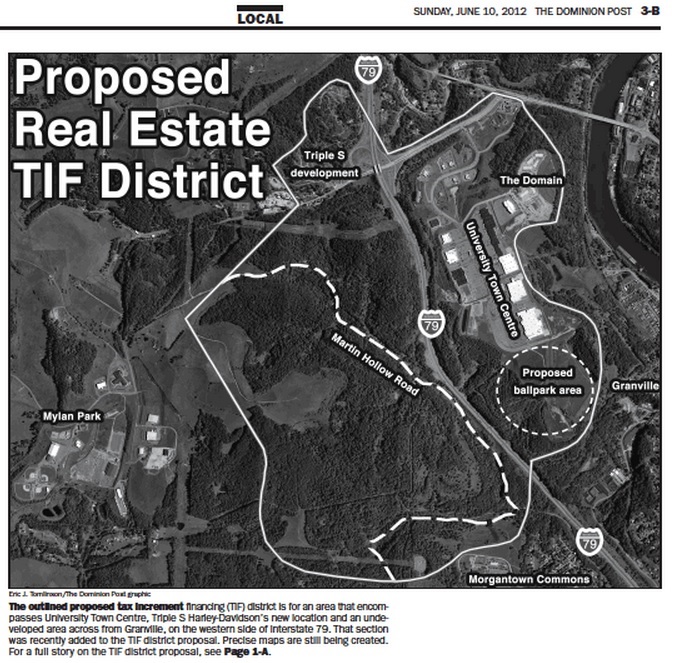
It has come to this in West Virginia. In the same year that the state has cut more than $13 million in funding to WVU, the state has approved and signed away multi-millions of state sales tax dollars to build a baseball stadium for WVU.

That’s right. The university gets cut financially by the state, while WVU sports, which are said to be paid for by the ostensibly “self-sustaining” WVU athletic department, gets millions of dollars from the state, via the TIF (Tax Increment Financing) swindle signed into law yesterday.

Why does no one, let alone any media outlet, comment on that scandalous juxtaposition: state financial cut to the university, state financial boon to WVU sports. That’s wrong. That’s backwards. That is what one would expect in a state that ranks dead last in well-being among the fifty states.

No WVU department or programs, office or services should allow the WVU administration to cut a dime from their budgets. No student tuition should be raised. No Cost Of Living Adjustment (COLA) should be disallowed by the administration. After all, WVU is currently loaning the ostensibly “self-sustaining” athletic department “about $12 million” and is awaiting the approximately $14 million gift baseball stadium from the state (and Monongalia County) TIF scam. So WVU has the money to offset this year’s state cuts to the university. Or, that is, it had the money, before diverting it to the athletic department. The university could readily raise the money by selling some of its investments and assets. Or even by tapping one of its bank accounts or fundraising arms. The university had millions of dollars on hand to lend to the athletic department and is throwing tens of millions of dollars into new construction projects left and right, and WVU recently reported that it saved $17.5 million by bond refinancing and had another $4.9 million freed up when new construction bids came in lower than expected. That alone is $22.4 million – far more than enough to offset this year’s $13.3 million cut from the state. Any cut to the university that WVU administrators blame on the state funding cut would be phony, another lie, and another swindle, not unlike the “ballpark” TIF. (More on that hijacking of public funds in forthcoming posts.)

What’s wrong with this picture?:

proposed TIF district

Read the rest of this entry »