Indoor Year-Round Recreation & Wellness Centers for the City of Morgantown

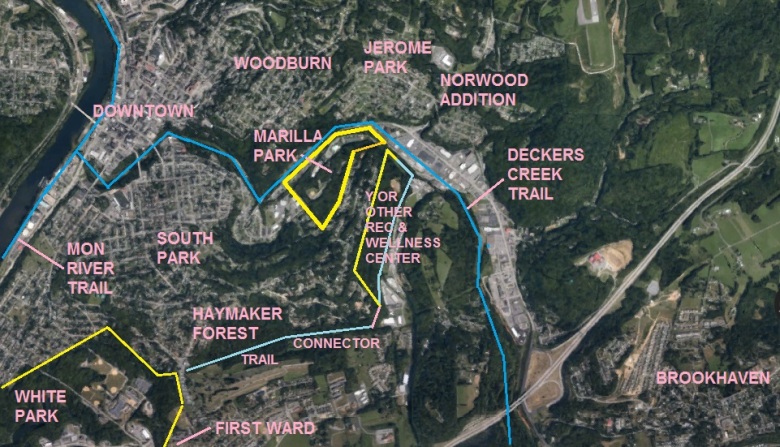
This map diagram shows a possible community recreation and wellness center site that has been suggested, with forested parkland acquisition, below South Hills, adjacent to Marilla Park, linking directly into a Haymaker Forest connector trail. 

Y or other wellness center

This could well be a great site for the city, and larger area. The site is on a slope, though one that has been partly flattened and cleared. The site sits above Green Bag Road, which is slated for near-term upgrades. A good, if very short, access trail to Marilla Park and Decker’s Creek Trail would need to be built, which would readily fit longstanding city planning.

The location would be extremely functional for many local residents, including via existing city green space parks and trails access and extension. Public purchase of the large forested tracts there along Green Bag Road would expand the city’s forested parks and green space in such a way as to advance the trail connection between White Park (and Mon River Trail), Haymaker Forest, Marilla Park, and Decker’s Creek Trail.

The possibility has long since been suggested of putting a Y or other rec and wellness center in the existing forest at Marilla Park. However that forested area is smaller and serves as a vital greenbelt of its own. And another new facility there could congest the existing park. Better to expand the park, or park system. So, instead a Marilla Park adjacent site below South Hills neighborhood and above Green Bag Road in a larger forest that is already partly knocked down, and the terrain leveled, could be extremely functional, while not overwhelming the local ecology. This location could bring a very important additional forest and trailway into the city to help complete a connector trail from White Park (and the Mon River Trail) to Haymaker Forest and to Marilla Park and to Decker’s Creek Trail and beyond (possibly per the map diagram above).

Not only is this site for a recreation and wellness facility a central and nearby location to the downtown neighborhoods, including via Deckers Creek Trail and a future connector trail between the parks, forest, creek, and river, this location would also give good car/bus access to Green Bag Road urban sprawl residents, as has been pointed out, as well as, at not much more of a stretch, the 8,000+ people of Brookhaven via Sabraton and Route 7.

In addition to this, a year-round indoor community recreation and wellness water center is very much needed on the Woodburn schoolgrounds, in that great space. Two such facilities could be well designed on these sites to complement one another, to meet the needs of the residents and neighborhoods of the four south and central wards in Morgantown: 1st, 2nd, 5th, and 6th. In this way, the green space and wellness community resources and benefits for the neighborhoods of the City of Morgantown, as well as for the intertwined nearby urban sprawl county areas and populations, would be greatly improved. Read the rest of this entry »

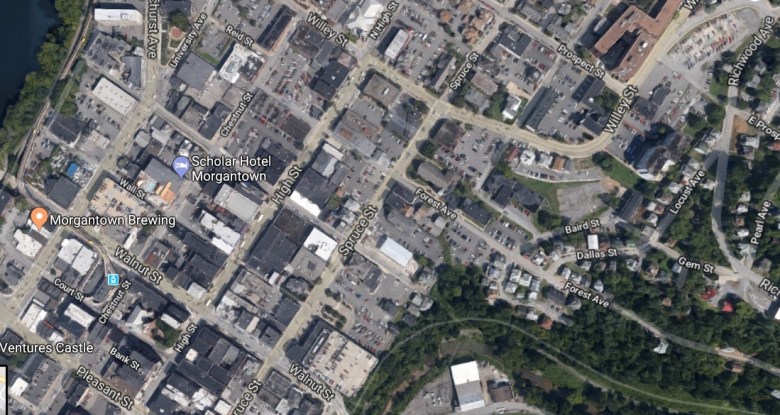
Doubleblind: The Menace of Route 119 Thruway Traffic on Spruce and High

Great editorial by Liana Krissoff on possibilities for revitalizing downtown (“A Walkable Downtown is a Sittable One,” Dominion Post, July 15).

The major structural problem with downtown Morgantown is that it is a cement gully of thruways, with nearly no tree shade and virtually no pedestrian malls or parklets. “Downtown” is a harried narrow traffic corridor, practically an industrial zone. Even the sidewalks are narrow and have the feel more of heavy machinery operations in an industrial park than of a stream of urban parklets and pedestrian plazas for shopping and obtaining public services, and for public congregating for walkabout exercise, entertainment, and socializing. The all-consuming traffic corridors of downtown – let alone the heavy trucks – gut the public social and economic nature and possibilities of Morgantown.

Why? Blame Route 119, which runs along basically 16 blocks of downtown, coming and going mainly on Spruce and High streets. Route 119 should cover only 4 blocks and not run along Spruce or High at all, only cross them. If this structural change were made, then the equivalent of at least half a dozen street blocks, mainly on Spruce and High, could be converted to tree shaded pedestrian malls or parklets, with adjacent tree-covered non-thruway parking and access drives.

Plaza & Parklet Downtown

This would provide the public much more relief from the sun in summer, much more space, much more leisure and exercise opportunities, much more room for pleasant outdoor social and public activities, and access to public services, while providing local businesses with the crowds they need to thrive. This would greatly transform – structurally and socially, environmentally and economically, the cement gully thruway that is currently downtown Morgantown.

Structurally, it’s an efficient if somewhat costly fix. The engineering would be impressive, possibly a swooping S shaped configuration south on (new) Route 119 from Willey Street to Beechhurst Avenue to manage the approximate 50 foot change in elevation over about 650 feet, as compared to the 40+ foot change in elevation over about 550 feet going north on Route 119, from University Avenue up Pleasant Street to High Street. This change would be less steep and more robust but otherwise similar to Campus Drive where it curves and changes 80 feet of elevation over 850 feet between Beechhurst Avenue and University Avenue. 

Route 119, which comes south from PA near UHS, then up Easton Hill and across the Mileground should not run across the Mileground into downtown. It should instead be diverted at the airport to run down Hartman Run Road (Route 857) to Route 7 and Green Bag Road, and then continue on up past Dorsey’s Knob, skirting downtown Morgantown entirely.

Route 119 traffic that actually needs to get to downtown would continue across the Mileground with interstate traffic and go through the roundabout onto Willey Street (while picking up traffic from Route 705). All this traffic would continue to follow Willey Street downhill, crossing Spruce Street to High Street, and instead of turning onto High Street, cross it to continue on Willey for an additional block. Then two new blocks of streets would need to be constructed by the state downhill through parking lots at that point to connect immediately with Beechhurst Avenue, at the existing intersection but reconfigured there on Beechhurst.

This simple realignment would remove ALL traffic of Route 119, the Mileground, Route 705, Wiley Street, and Richwood Avenue, etc, from the downtown main streets of Spruce and High, which could then be converted largely to tree-covered pedestrian malls, with some non-thruway parking and some limited-access non-thruway drives. 

Route 7 with its heavy trucks could and should also be diverted from downtown (including the bit of Spruce Street that it destroys each year) and onto Green Bag Road, with forthcoming improvements there. Even without a Route 7 diversion, a serious Route 119 realignment would greatly transform downtown, create it anew.

It’s time to get rid of the menace that is Route 119, and all of its conjoined traffic on Spruce and High, which is largely to blame for the existing cement gully of downtown Morgantown that is the cause of many of downtown’s business, social, health, structural, and environmental problems.

Meanwhile, the end of Green Bag Road should be aligned into a single intersection with the end of Smithtown Road to get rid of the insanity of that deadly double-blind intersection there. The City, County, and State all have known financial mechanisms that could fund that studied and known fix there, at any time they feel so inclined to get it done. The public should actively press for these badly needed changes and improvements.

Satellite maps show that not only is downtown a cement gully (traffic corridors) with no tree canopy but basically a sprawling paved parking wasteland with no tree canopy. Both conditions are destructive of public, social, and economic life (not to mention health, environment, ecology).

Because of the local geography, downtown will always be a hub of traffic. An engulfing web of roads feeds to and through it. That will always be the case. The question is to what extreme. Everything will continue to feed toward downtown but much less should feed through the very center of downtown.

That any US or state route runs through central downtown Morgantown main streets at this point – let alone for dozens of downtown blocks (Spruce, High, Pleasant, Walnut, Brockway) – is an abomination for city life. Long ago it was necessary. Now it is a menace, including for drivers just trying to get through.

Downtown Morgantown needs the shock to the system that blocking off Spruce and High would bring, in my view. Readily re-locating Routes 119 and 7 is imperative. A third parking garage could enable the city to begin to cover the remaining downtown lots and areas with tree canopy.

It is also conceivable, maybe more conceivable, that central Spruce and High could be well converted to combos of pedestrian mall and essentially single lane, one way semi-thru-parking lots with angle parking, not parallel parking, and the sidewalk greatly expanded along one side of each street into a green mall.

Any way you go, you have to get the nearly two dozen blocks of US/state routes entirely out of that downtown area/corridor. This is the only way to eliminate thru traffic and create enough space (while maintaining parking) to get a significant tree cover into downtown. Instead, you could try to take out or reduce the parking lots and plant trees but that won’t be supported enough to matter, especially with the high amount of thru traffic and big events that sometimes occupy all the spots. Not to mention lunch hour, in some locations. In any case, the tree canopy is needed for pedestrians, and crowds, and pedestrian activities (like shopping, residing, servicing, exercising), not for the existing enormous amount of commuters and thru traffic.

Downtown is a chaotic mess because it is primarily a drivethru zone and not primarily a destination zone. It will always be a hub of driving, transportation. Now it needs to take the next step to not be the sliced and diced gully and paved wasteland of a commuter corridor and industrial cut-through that it currently is.

In the meantime, getting a really green parklet into downtown would be a great accomplishment (as significant or more significant than the farmer’s market area, in my opinion) and potentially give much impetus and vision to Liana Krissoff’s larger green web idea. It would better show the need, benefit, and possibilities for rerouting the arterial roads too.

This?:

Cement Gully Downtown

Or this?:

Plaza & Parklet Downtown

Morgantown City Council Town Hall & The Future Of City Issues

So at the Morgantown City Council Town Hall today, Saturday, 9-noon, there were by my count at its high point, 33 people in the Met Theater audience seats and 11 support personnel for the city, including 6 Councilors, 1 City Manager, 1 moderator, 2 police officers, and 1 lighting technician. The people in attendance were more or less evenly split on their views, and there were only about three dozen or less.

This shows that the City Council basically has a clear mandate to do as it sees fit on the main issues of the day, especially in accord with the interests and needs of their constituents who elected them.

This Town Hall shows that City Council should move forward with all possible speed in deliberating and deciding to a) purchase Haymaker Forest, b) provide referendums for levies for community needs for the public to vote on in November, and c) further pursue annexation of the urban sprawl county areas that are overwhelming the city’s borders, infrastructure, and services.

The scheduled moderator, the “President and CEO of the Morgantown Area Chamber of Commerce,” arrived late, after the first question had been asked and partly answered, and he offered no apology for being late. Even if his excuse was a good one – traffic accident? – he offered no explanation.

No one seemed surprised, let alone asked for an explanation or apology from the “President and CEO of the Morgantown Area Chamber of Commerce.” Does he work more for the “Area” than for the “City of Morgantown”? Did he have an “Area” meeting that he had to attend prior to the Town Hall put on by the Morgantown City Council? One can only wonder.

In any event, one thing is clear. The Morgantown City Councilors evidently have retained their mandate to act as they see fit on the public’s behalf, throughout the second year of their two year term. Let’s hope the Councilors take that mandate ever more seriously and act on it ever more strongly over the course of the remaining year, for the public good, both near and long term.

History of the Battle for Haymaker Forest (Part Two)

The battle for Haymaker Forest is now entering its fourth year, here in the second half of summer, 2018.

On August 7, 2015, Doug Warden, representing Cheat Road Engineering, submitted a request for an estimate from MUB for water/sewer/storm service for a highly detailed proposed new subdivision.   https://newwoodburncommunityschool.org/wp-content/uploads/…/06…

The planned development spanned the entire breadth of Haymaker Forest.   https://newwoodburncommunityschool.org/wp-content/uploads/…/mu…

The plans for this proposed new development had been accidentally discovered earlier in the summer by a local resident who found an engineering map of the design on the edge of the woods.   https://newwoodburncommunityschool.org/wp-content/uploads/…/su…

Over the course of months, MUB drew up and released the plans to the developer. None of this was known or reported publicly except by concerned residents who filed Freedom of Information Act (FOIA) requests of MUB, the city, and elsewhere in a determined effort to find out what was going on, and who knew what.

By late spring the following year, May 2016, Mr. Warden appeared before the Morgantown City Planning Commission to request street access for the new subdivision into the city on a dangerous steep curve of Buckhannon Ave. The Planning Commission refused to approve the request in the face of dozens of residents from multiple neighborhoods who spoke out against any new subdivision’s access to Buckhannon Ave. No one other than Mr. Warden spoke for access.   https://www.facebook.com/groups/1063344577038302/permalink/1122247004481392/

Eight months earlier, three Neighborhood Associations of communities adjacent to Haymaker Forest had presented a formal position paper to City Council and County Commission opposing the proposed new development’s access at Buckhannon and calling for the “public purchase and stewardship” of as much of Haymaker Forest as possible to preserve the environment, the wildlife, the ecology, and to preserve the health, well-being, and the quality of life of the many residents in the adjacent neighborhoods and in the city and county in general.  https://newwoodburncommunityschool.org/2018/07/15/history-of-the-battle-for-haymaker-forest/

This was a big victory for the effort to save Haymaker Forest, when a wide variety of residents turned out at the city’s Planning Commission meeting causing the Commission to block the developer’s proposal by tabling it. Then in August 2016, Cheat Road Engineering withdrew its development proposal entirely from the Planning Commission agenda. Another victory. However, as the Dominion Post reported, city engineer Chris Fletcher stated his expectation that plans for a new subdivision were likely to be drawn up.   https://www.facebook.com/groups/1063344577038302/permalink/1122247004481392/

And this is exactly what happened. By February of 2017, a new development design was created by Cheat Road Engineering again across all of Haymaker Forest.   https://www.facebook.com/groups/1063344577038302/permalink/1294076123965145/

This time, street access to the redesigned development was plotted primarily via Dorsey Avenue, which is state controlled, and in the County at that juncture, with no City control, though very close to the boundary line between the City of Morgantown’s First and Second wards. The developer’s bulldozers could plow through at any moment in this large county portion of the Forest. The City could not stop anything. And roll in a bulldozer did, without any public warning, in April 2018 to clear ground for the taking of bore samples, presumably to determine road and building foundation requirements.   https://www.facebook.com/groups/1063344577038302/permalink/1818300294876056/

Fortunately, the next major victory in the battle for Haymaker Forest had culminated almost exactly one year prior to the first bulldozer grinding into the forest: Morgantown city election day in April 2017, when two of the three City Councilors representing city wards bordering Haymaker Forest, who had moved ineffectively or not at all on saving the forest, were handed two huge defeats. Councilor Redmond and Councilor Bane lost in a landslide to Mark Brazaitis and Rachel Fetty, who gathered the second highest and the highest number of votes of all the candidates. The battle for Haymaker Forest fueled that entire city election. People from many backgrounds did a lot of work, in particular Bernie Sanders supporters. And the people who had been working and turning out to help save Haymaker were as actively involved as anyone. Mark Brazaitis had made a centerpiece of his campaign the preservation of Haymaker Forest – the only way to protect the wildlife, ecology, and environment and to preserve the quality of life of the adjacent neighborhoods and of the city and county in general. He called upon any and all entities, private and public, to act to preserve this local community forest facing imminent destruction.

Many basically fruitless efforts had been made to secure funds for saving Haymaker Forest. Even a reluctant Councilor Redmond had been enlisted, and he noted the varied organizational and individual efforts being made to protect Haymaker Forest and the adjacent neighborhoods as early as October 2015, per his email response to concerned citizens of that month and year.   https://newwoodburncommunityschool.org/2018/06/12/early-history-on-the-battle-for-haymaker-forest/

Local area residents across 3 of the 7 City Wards bordering the forest, along with residents citywide and in the county, had since the summer of 2015 considered every possible funding and preservation option for Haymaker Forest that anyone could think of, and tried to pursue whatever seemed most feasible. These efforts spanned possible city, state, federal, environmental, university, and private funding sources. Further efforts and appeals were made to the County as well, to no funding effect. Plainly, multi-million dollars were needed, and no entity with the resources was willing to step up. Many were called. None answered, with anything by way of even a partial solution. (The one entity that came closest to helping was the West Virginia Land Trust, which offered some valuable ideas but had no dollars to spare.)

During one effort to secure funding, in fall of 2015, concerned residents proposed that the City Council dedicate a portion of the soon-to-be-voted-on User Fee to permanently fund both green space acquisition, such as Haymaker Forest, and ongoing BOPARC activities and infrastructure. This made some minimal progress with the City Council at that time, before being entirely dismissed. Not so much as a cent would go to green space. Much else was considered and explored from then on, with no funds ever being secured.

That’s why the City Council elections of April 2017 were such a huge victory in the long battle toward saving Haymaker Forest. Council has subsequently proven willing to consider a referendum and other funding mechanisms, which are more progressive than the User Fee, to save Haymaker Forest. The three Councilors known to be most opposed to spending city money on protecting the forest were resoundingly defeated, while the vocal proponent for preserving the forest, Mark Brazaitis, was overwhelmingly elected, as was every single one of his allies at the time, with no losses. http://thecityofmorgantown.com/…/morgantown-city-council-wi…

From the unsuccessful but strong public requests and proposals to City Council (and other public agencies) to buy and protect the Haymaker Forest for the public in the fall of 2015, to the great public turnout at the city’s Planning Commission meeting in May of 2016 that successfully blocked temporarily the proposed new development, to the sweeping success of the April 2017 City Council elections that removed the 3 councilors most opposed to any forest purchase and brought in at least several strong advocates for its purchase, to the remarkable summer of 2018 City Council plans and proposals for a green space acquisition referendum and City purchase of the forest for the public, to the ongoing negotiations between the City and the current forest owners to save the community forest for the public once and for all, the battle for Haymaker Forest has proven to be the proverbial long and winding road.

Why This Matters: The Battle for Haymaker Forest

Why this matters

If we can’t save the forest, we can’t save ourselves.

If we can’t save our parks, we can’t save ourselves.

If we can’t save our neighborhoods, we can’t save ourselves.

If we can’t save our libraries, we can’t save ourselves.

If we can’t save our sidewalks, we can’t save ourselves.

If we can’t save Woodburn schoolgrounds, we can’t save ourselves.

If we can’t save Krepps pool, we can’t save ourselves.

If we can’t save our roads, we can’t save ourselves.

If we can’t save our trails, we can’t save ourselves.

If we can’t save our public services, we can’t save ourselves.

If we lose a car dealership, because it doesn’t like to be annexed into the city to pay city taxes like every other business in the city, who cares? We haven’t lost anything. We can go to another car dealership. Or another car dealership will move in.

If we lose a car dealership, we haven’t lost anything. More importantly, we haven’t lost ourselves.

If we lose a restaurant, because is doesn’t like to be annexed into the city, who cares? Another restaurant will move in. Probably a better one!

If we lose a restaurant, we haven’t lost anything. More importantly, we haven’t lost ourselves.

If we can’t annex, we can’t save ourselves, we can’t know ourselves, we can’t grow ourselves.

If we can’t save the trees, we can’t save ourselves.

If we can’t save our wildlife, our ecology, our environment, we can’t save ourselves.

The air in Morgantown is polluted enough already. Why would we want to make it more polluted downtown by removing the great pollution filter that is Haymaker Forest?

If we can’t save Haymaker Forest, we can’t breath as well. We can’t save ourselves.

If we can’t save the community park that is the forest, if we can’t save the pure West Virginia hollow that is Haymaker Forest, we can’t save ourselves.

If we can’t save our neighborhood services and structures and parks, we can’t save ourselves.

If we can’t win the Battle for Haymaker Forest, we can’t save ourselves.

That’s why all this matters. If we can’t save our communities, no one else will.

If we can’t save the forest, we can’t save our communities.

If we can’t save our communities, we can’t save ourselves.

If we can’t save the trees, if we can’t save Haymaker, if we can’t save this wild and wonderful little piece of the planet, then we can’t save ourselves.

That’s why all this matters.

We are trying to save ourselves here, folks. Here and now.

Let’s bring Haymaker Forest back to a vote. Let’s get Haymaker Forest back. Let’s end the postponement. Let’s vote!

If we can’t save Haymaker Forest, we can’t save ourselves.

Image may contain: outdoor

History of the Battle for Haymaker Forest (Part One)

The local historical and political magnitude of the ongoing battle for Haymaker Forest is probably still too little understood. It began in the summer of 2015 when a local resident found a map on the edge of the woods dropped by a land surveyor. The engineering map depicted a massive new development located mostly in the county but also in the city that was designed to stretch from Dorsey Avenue at the boundary of Morgantown’s 1st Ward, running along a thruway with multiple spokes past the entire top of Morgantown’s 2nd Ward, over to Morgantown’s 6th Ward, with the thruway exiting in the city on Buckhannon Avenue where upper South Park neighborhood meets South Hills neighborhood, not far from Southpoint Circle neighborhood. Again, this was summer 2015, three full years ago.

As far as is known, everyone in the surrounding neighborhoods was appalled. Appalled that the impending development was discovered accidentally with no public notification, appalled at the consequence of a major influx of pollution and new traffic on substandard roads in long-established neighborhoods, appalled at the impending destruction of the forest, its ecology, environment, and wildlife. Almost immediately, a tri-neighborhood committee was formed consisting of neighborhood officials and residents. Within a few months, the committee drafted a tri-neighborhood position paper soon presented in October 2015 to Morgantown City Council and to Monongalia County Commission calling for the “public purchase and stewardship of as much of [Haymaker Forest] as possible.”

Prior to being presented to City Council, three Neighborhood Association Presidents signed the Position Paper, and two attended the City Council presentation: Bill Wasson, President of Southpoint Circle Neighborhood Association, and Paul Steel, President of South Park Neighborhood Association. The third President, Dave Harshbarger of South Hills Neighborhood Association could not attend and eventually appeared at a subsequent City Council meeting where he appealed to the Council to preserve Haymaker Forest.

The three neighborhoods’ Position Paper of 2015 noted that longstanding city planning bore directly on the matter, in many ways:

“In firm alignment with the vision and blueprint of Morgantown’s Comprehensive Plan, these several city neighborhoods are committed to protecting and promoting: 1) the local ecology, its environment, wildlife, woods, and green space; 2) the safety and quality of life of the local neighborhoods; 3) and the overall well-being of the city and county. /// The development project would grossly impact adjacent neighborhoods and the city as a whole. We are committed to maintaining and improving city livability: by minimizing neighborhood through traffic, by maximizing safety and walkability, by preserving the environment, by protecting wildlife, by providing open space for healthy exercise and enjoyment, by boosting social and economic well-being in alignment with Morgantown’s vision and blueprint. Such commitment has the potential to raise the bar for maintaining and improving quality of life in both longstanding neighborhoods and in new areas of the city.”

It soon became increasingly well understood that while the land remained privately held, by all appearances it had been abandoned by its owners. Haymaker Forest had long since been outfitted with complex trails and had long since become a community park, a community forest, of the residents of the multiple surrounding city neighborhoods and city wards and nearby urban county pockets. In fact, nearly half of the city wards, 3 of the 7, border or contain Haymaker Forest to a significant degree, as do the homes of nearby county residents. People from all these neighborhoods had been using the forest as a community park for decades.

Despite the public appeals (both formal and informal of the three city neighborhoods and other residents) to protect this cross-border forest in accord with popular concerns and quality of life values large and larger – and very much in accord with the highly detailed land management and conservation maps in both the City and County Comprehensive Plans – nothing was attempted by the County, and the efforts and achievements of the City were limited, at first, to protect Haymaker Forest. Until things changed. Remarkably, after the multiple communities’ self-generated initial strong efforts in the summer/fall of 2015, the public managed a series of impressive achievements over the course of the next two and half years, with three major turning points: the first in the spring/summer of 2016, and then again in 2017, and finally another huge push in 2018 during recent months. These further historical moments will be detailed in a subsequent post, to bring the long road and the ongoing history of the battle for Haymaker Forest to its current point.

See:  History of the Battle for Haymaker Forest (Part Two)

Report for the City of Morgantown on the Value of Haymaker Forest

http://morgantownwv.gov/…/Vi…/2116/Haymaker_forest_qualities

Some highlights from “Haymaker Forest” by Rick Landenberger and WV Land Trust:

Once protected, the property will forever function as an effective pollution and runoff filter (Figure 2) for lower Aaron’s Creek and the growing communities along its lower reaches and in Sabraton, saving millions of dollars over time in stormwater damages. …

In a study published by the U.S. Forest Service (Nowak et al. 2004), seven researchers, including a WVU faculty member, calculated specific economic benefits of Morgantown’s forested areas. Although the study focused on the entire city, the monetary benefits it highlighted apply to Haymaker Forest. Morgantown’s forests, the study’s abstract concludes, store “about 93,000 tons of carbon valued at $1.9 million. In addition, these trees remove about 2,900 tons of carbon per year ($60,000 per year), with trees and shrubs removing about 104 tons of air pollution per year ($711,000 per year). Trees in Morgantown are estimated to reduce annual residential energy costs by $380,000 per year. The structural, or compensatory, value is estimated at $488 million.” …

In summary, the total value to the Morgantown and Monongalia County community of an undeveloped, protected Haymaker Forest greatly outweighs the value of development. Not only is this clear today, when Morgantown is growing rapidly and losing much of its natural qualities, but it will be even more obvious in coming years, when population and environmental pressures will be magnified due to climate change and human migration to water-rich areas. Securing the Haymaker Forest for public use and protection makes both short-term and long-term economic sense. Likewise, Morgantown and Mon County residents and visitors will enjoy its incalculable benefits—as a recreation area, as a place of refuge within a busy city—today, tomorrow, and forever.

The Value of a Forest

These folks know the value of a forest: “America’s tree sitters risk lives on the front line.”

Support for Haymaker Forest

You didn’t see this much reported in the news: On June 5, the morning of the 6-1 City Council vote in favor of purchasing Haymaker Forest for $5.2 million, the right-wing, big business morning talk show on WAJR conducted a poll about whether or not the 40 acres of Haymaker Forest should be purchased for $5.2 million dollars. The two hosts sounded totally depressed and defeated by the end of the show when their own poll of their right-wing, don’t-tax-me audience showed that nearly 40 percent supported buying the Haymaker Forest for $5.2 million.

The forest actually spans about 42 acres rather than the 40 noted in the poll, making the buy an even better deal.

Then, after two weeks of WAJR demonizing the forest buy, and after a politically motivated and politically orchestrated turnout effort, an extremely misleading public presence showed up at City Council on June 19 that opposed the forest buy.

However, one week later, at City Council’s Committee of the Whole meeting, the public presence at Council was flipped back to being overwhelmingly in favor of support to buy the forest: many more people spoke in favor of buying the forest than the very few who spoke against it.

Morgantown City Council needs to realize that as far as anyone knows, as far as anyone can tell, and as far as seems likely, the Council retains the overwhelming popular and public support for the issues that they campaigned on and won on, to get elected to Council, including the idea of preserving Haymaker Forest for all time. Therefore, the City Council would be both foolish and irresponsible if it were to decide not to vote to buy Haymaker Forest, even at the $5.2 million price, let alone at a lower price, should it be brought back up for a vote.

Yes, the city hired an appraiser who appraised the property at $2.5 million, far under the seller’s asking price of $5.2 million. However, sellers are far more likely to sell their property at or near their own price, rather than at or near the price offered by the buyer, whether appraised or not.

The Haymaker Forest should be brought back to a revote as soon as possible, with the price lowered as much as possible. However, even at $5.2 million, Haymaker Forest is a steal. What if another interested buyer comes in at any moment, a developer, for example, and causes the price to go up? By its delay, the City is risking losing the forest forever.

The forest could have been owned by the City by now. It’s worth it. There is little to no reason to think that buying Haymaker Forest even now at $5.2 million would not be a popular vote. Saving the forest for the communities is a very popular and a very valuable thing. The price is worth it. The City must act before it is too late.

Making Morgantown Poor

Today on WAJR, the morning show hosts expressed if anything a surprised reaction (“hmm”) to a caller telling them that the hockey team helped build and pay for the BOPARC ice rink, and that WVU contributed to a room in it, and that donations came from Jack Roberts’ sister, and that Jack Roberts donated the park to BOPARC and the public in 1st ward neighborhood. Surely the hosts did not miss that all such funding now is flooding out of the neighborhoods and out of the city park system into Mylan Park where no one lives.

Another caller stated that WVU originally said its rec center would be open to the public but then had to disallow that when it feared losing its non-profit status.

This is how to make Morgantown poor. This is how Mylan Park makes Morgantown poor. Major private donations and WVU funding and grants that previously went to the area’s major city park system, spread widely through all of Morgantown’s neighborhoods and near densely populated urban county developments, all those millions and tens of millions of dollars now go primarily to Mylan Park where virtually no one lives, far from the many neighborhoods.

This is a recipe for further city blight of infrastructure, lack of green space and wellness activities, increased social and community decay, and the collapse of urban livability.

Where is a YMCA or other rec and wellness center for any of the city neighborhoods? Fairplay, Colorado, a crossroads town of 760 people, using two bonds, built a remarkable multi-million dollar year-round indoor water facility, community and wellness center on a scant few acres. Where is a similar center for the Woodburn schoolgrounds?

No, you can’t have it. Not the neighborhoods, not the communities. But Mylan Park can have it, a private entity, funded by wealthy donors. The city where tens of thousands of people live is instead gutted, made poor.

Monongalia County doesn’t even have a park system, not one single facility, for its tens of thousands of urban county residents around the fringes of Morgantown, Star City, and Westover. It has three parks for its many rural residents but nothing nearby for its urban residents in the many crowded housing developments of greater Morgantown. And the county pays virtually nothing ($50,000 this year) of the several million dollar budget of Morgantown’s city park system, BOPARC, even though half of BOPARC users are from outside the city. (Yes, there is a $2.5 million county levy to repair the BOPARC ice rink, but city residents are taxed for that levy too, just like any non-city resident).

This is how the city of Morgantown is made poor. Mylan Park makes BOPARC poor. Private, state, and county dollars that formerly would go to the many BOPARC green spaces and facilities and trails throughout the city neighborhoods, including near densely populated county areas, now go into the no-man’s-land of Mylan Park.

Monongalia County has committed $150,000 to Mylan Park – a private entity – while supporting BOPARC to the tune of a mere $50,000 – a public entity. All the while, Monongalia County has no urban county resident park system, at all.

This is how Morgantown and the greater Morgantown area is made poor.

And then there is annexation and the longstanding record of wealthy entities and the County Commission’s open hostility to the City of Morgantown expanding to encompass all the urban residences and urban commerce surrounding its borders. These people and business benefit from city-based consumption and from city structures and planning and services while not paying any of the taxes (B&O and property taxes) to the city that actually sustain the conditions off of which the businesses profit and the urban county residents use and enjoy.

This is how Morgantown is made poor. This is how the city Park System, BOPARC, is made poor. And urban county residents suffer too. The whole region suffers.

WVU has its own rec center for its students and faculty, and some shared public green space and facilities, if you can afford them, but this does not remotely compensate for what Morgantown’s BOPARC system and rail trails and neighborhood parks offer – largely free – to virtually all WVU employees, families, and also students, often right in the communities where they live. How much does WVU support BOPARC compared to the use of the system by its employees and students and its value to them? How much does Westover and Star City support BOPARC compared to the use of the system by its residents? How much does the county support BOPARC compared to the extremely heavy use of the system by the non-city residents, especially its urban county residents who have no neighborhood park system of their own?

The park systems of Star City and Granville and even Westover and the Brookhaven and Cheat Lake urban populations (let alone the non-existent park system of the other urban county residents flooding all around Morgantown’s borders), these systems or facilities do not remotely compare to the amenities offered by Morgantown’s BOPARC system with its pools, skate park, rail trails, tennis courts, ice rink, and so on, even in their currently impoverished state. And what do these population bases pay into the BOPARC system that they use heavily? The County should correct this inequity. $50,000 doesn’t cut it. Chump change.

It’s scandalous. This is how Morgantown is made poor.

This is why a county BOPARC levy is needed immediately this November, and not at the next opportunity two years from now during the next election.

Otherwise, we’ve all been cheated of our chance to decide for ourselves, yet again. And the County – which should provide a dedicated funding stream for BOPARC independent of any levy – would be derelict again. Does the County want to see that the City gets what it needs? Even has a chance, via a referendum for a levy, to get what it needs?

Or not. You can almost see the Commissioners thinking, if we can just wait the Council out, then we won’t have to allow a levy for another two years, if at all! How inspiring.

The WAJR morning show hosts, under the orders of their One Percent bosses, can whine and moan all they want about Morgantown City Council rushing – valiantly – to do what should have been done decades ago, making up for lost time. City Council is only elected on two year terms. Five of the members are new and more forward-thinking than in years past, in general. They’ve had a lot to take in and a lot to learn, and they are beginning to see, some of them, how the city has been shafted for years. And they are beginning to see, some of them, the need for urgency in the moment.

The hosts of the WAJR morning show don’t live in the city. Do they even live in the county? The state? Doesn’t one live in Pennsylvania? A former host lived in Preston County, let alone in the city of Morgantown. Does the other host even live in Monongalia County? And yet they sit there and blather as the One Percent’s judge and jury on the city of Morgantown because they don’t want the wealthy business community that they sing the praises of day in and day out to pay city property taxes or the levy taxes to support city infrastructure and services and planning that those businesses draw wealth off of in the first place. They don’t want their One Percent heroes’ property taxes to go toward making the many urban neighborhoods more livable than they would be otherwise. Let WVU and the wealthy businesses give their money now to Mylan Park! Let them be free to build their paradise apart! And let the people be free to wander the dilapidated parks. To hell with BOPARC and the urban neighborhoods! Where the people actually live. To hell with them.

Hey, don’t move to fund BOPARC! Let Mylan Park thrive! Let WVU glisten! To hell with Morgantown. Who cares about those tens of thousands of people, and the many more all around the perimeter?

Let the outrage and the scandal and the city and social decay continue. Let all the crowded people in their crowded conditions rot to the ground.

Let the people pilgrimage to Mylan Park! To pay their respects. And their dues. That’s what the County Commissioners do. Everyone follow!

And let them eat cake along the way. Let the people eat cake in their neighborhoods too. Give them cake, a few crumbs here and there. Because there is no bread. Not nearly enough bread for their communities. It went to Mylan Park. The loaves pass from one deep pocket to another. If you’re lucky, you can drive to Mylan’s Park, the One Percent Park, or pay a bus pass for the tedious ride there, and then you can pay to get in.

That’s how you make Morgantown poor.
What is a “fiscal conservative”?

“Fiscal conservatism is a political-economic philosophy regarding fiscal policy and fiscal responsibility advocating low taxes, reduced government spending and minimal government debt. Free trade, deregulation of the economy, lower taxes, and privatization are the defining qualities of fiscal conservatism.” -Wikipedia

A “fiscal conservative” is an apologist for the profiteering One Percent. Anyone on City Council who calls themselves a “fiscal conservative” should be voted off, because they are not working on behalf of the people, the public, they are working on behalf of the profiteers, the One Percent, against the public.

Local talk and news host Hoppy Kercheval is a fiscal conservative, a cheerleader for profiteering. He is basically a lobbyist for the One Percent, which employs him to propagandize for the interests of the big owners and big business against everyone else, against the public.

Fiscal conservatives are WAJR and WV Metro News. Fiscal conservatives oppose government generation of revenue to meet public needs as much as possible. Why? Because fiscal conservatives don’t want the wealthy owners of land and businesses to be taxed by levies, property taxes (or by income taxes).

Fiscal conservatives like Hoppy Kercheval function as the enemies of strong cities and strong public governments that try to generate the badly needed revenue to meet public needs, like revenue for the building and repair of public structures and services like roads and sidewalks and parks and libraries. Fiscal conservatives, the profiteering One Percent, are fighting the city’s acquisition of Haymaker Forest tooth and nail. Fiscal conservatives are battling the neighborhoods, the communities, the people.

That’s why any Councilor who calls him or herself a fiscal conservative should be voted out at the first opportunity. Which side are you on? If you are not on the side of the people, the 99 percent, then you should not represent them, because you don’t.

Save Lives: Light the Trails

Why isn’t Deckers Creek Trail lit up like a string of Christmas lights around a Christmas tree from Sabraton to downtown Morgantown? Did Divante Coles die because Deckers Creek Trail is not a well lit, active night trail, welcoming to bicyclists? Wouldn’t bicyclists choose a well lit park trail over the extremely dangerous route 7 which the wide, paved rail trail parallels all the way from Sabraton to downtown Morgantown? Reportedly, Divonte Coles was fatally struck on route 7 near the Dominion Post offices, going toward Morgantown after getting off work in Sabraton. Why not make this rail trail readily usable 24/7, if for no other reason than to keep bicyclists safe from route 7? Possibly even simply installed solar panels would create sufficient and safe lighting.

WAJR.COM
MORGANTOWN, W.Va. — Police are still sorting through surveillance footage in an effort to find the person responsible in the death of a bicyclist in…

This Land Is Your Land

As the battle for Haymaker Forest rolls on, Woody Guthrie’s great song seems more than appropriate: This Land is Your Land.